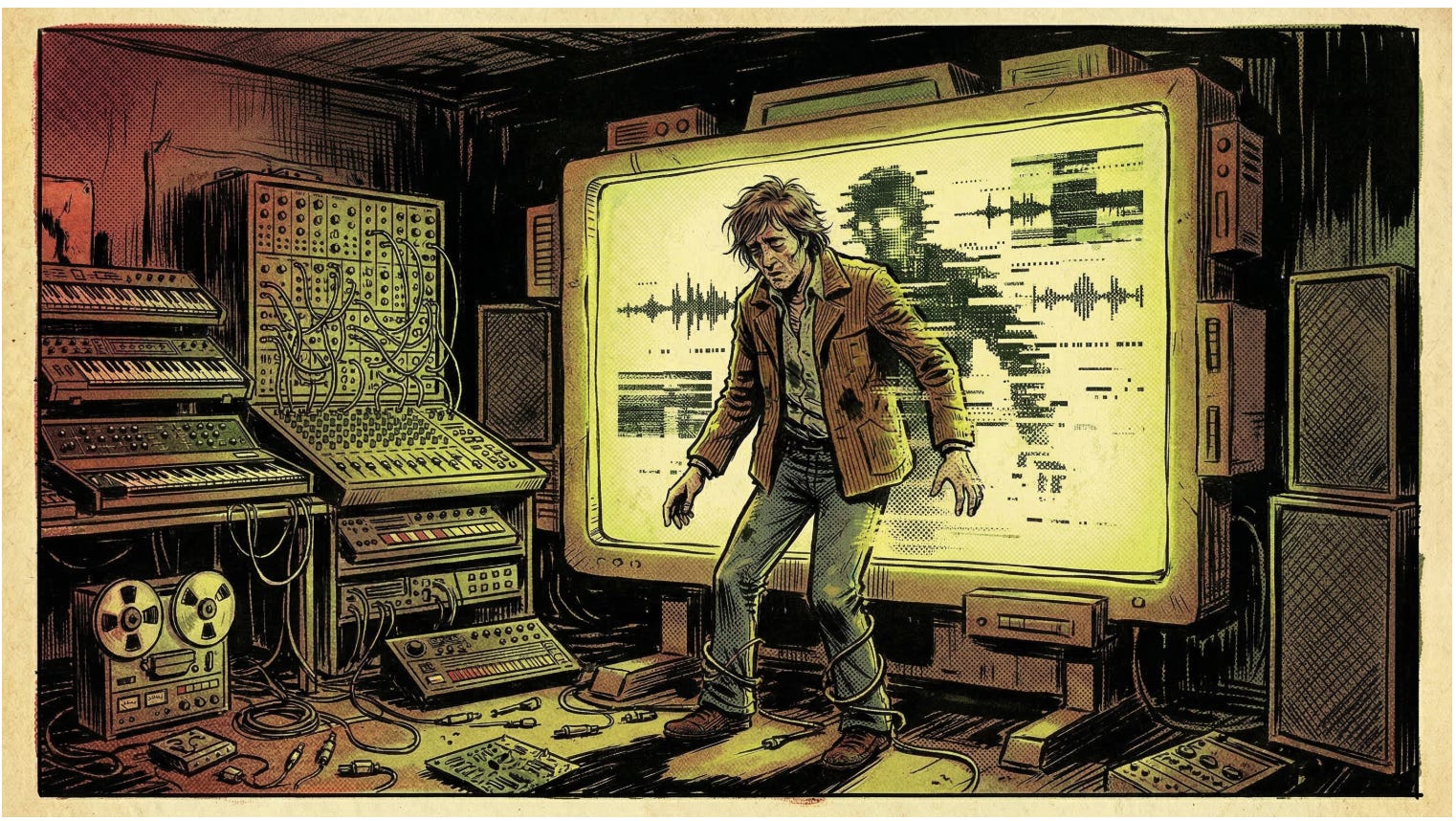
Soundtrack:Cooling Array Chamer 09 - Sublevel Operator
Most artists don’t notice when it happens.
At first, the platform is just a tool. A place to share the work. Then it becomes a place to share the process. Then the thoughts behind the process. Then the morning routine, the worldview, the personality, the entire self.
And somewhere along the way, the balance shifts.
The work stops being the thing.
The artist becomes the thing.
That’s the trade. The platform offers visibility, but in return it asks for proximity. More access. More frequency. More of you.
And if you’re not careful, you start making for the feed instead of making for the work.
That’s when the platform stops serving the artist and starts consuming them.
The mistake is thinking these platforms are stages.
They’re not stages. They’re billboards.
A stage is where the performance happens. A billboard just points.
It’s not meant to hold the whole experience. It’s meant to create enough tension, enough intrigue, enough interest that someone decides to go deeper.
That changes the question.
Not, how do I show up more?
But, where do I want people to go after they see me?
That’s a different posture entirely.
A lot of artists miss this because they run everything through the same identity. The art, the marketing, the updates, the distribution, the presence. All of it gets collapsed into one public self.
But separation creates leverage.
If the ads, campaigns, and promotional machinery run through a label, a project, or some other entity, then the artist gets to stay intact. More intentional. More curated. Less available.
That matters.
Because constant availability doesn’t make an artist feel important. Usually it does the opposite.
When someone can have endless access to you, they stop valuing the moment they actually encounter the work.
Predictability makes things easier to consume.
It rarely makes them more memorable.
And art doesn’t live on convenience. It lives on tension. Contrast. Timing. Surprise.
That’s why absence can be powerful.
Not disappearance for the sake of being difficult. Not artificial mystery. Just restraint.
When an artist isn’t constantly present, people notice. They ask where the work lives. They look a little harder. They lean in.
That small moment of friction is useful.
Because the moment someone has to seek you out, the relationship changes. You are no longer just another presence passing through the feed. You become someone worth finding.
And being sought out is more powerful than being constantly available.
There is, I think, one important exception.
YouTube.
Not as a social platform, but as a search engine for intent.
People go there looking for something. A song. A performance. A session. A moment that matters to them.
That’s different from platforms built around personality loops and endless interruption.
On YouTube, the work still has a chance to lead.
Not the breakfast. Not the opinions. Not the daily proof of existence.
The work.
Which suggests a different model.
Let paid media do the work of visibility.
Let discovery lead people to the art.
Let the art live somewhere that can hold it properly.
And let the artist remain a little out of reach.
Not invisible. Just not overexposed.
Because overexposure flattens meaning.
Imagine releasing something and letting the audience encounter only what matters. They hear about it. They see a signal. They search. What they find is not an endless trail of commentary and casual access. What they find is the work itself.
Cleanly. Directly. Without all the surrounding noise.
That feels different.
It feels like intention.
And intention changes perception.
This is really the whole thing.
Not a platform strategy. Not a content plan. An identity decision.
Are you trying to remain present in the feed?
Or are you building something people will want to discover?
Those are very different paths.
One says: here I am, keep noticing me.
The other says: the work is here when you’re ready.
Only one of those creates gravity.
So maybe the goal isn’t to post more. Maybe it isn’t to disappear either.
Maybe the goal is simply to choose where you exist, and to be disciplined about what belongs there.
Use the platform to point.
Use the work to hold attention.
Keep some part of yourself outside the machine.
Because the artist who controls their presence has a better chance of controlling their meaning.
And in the end, meaning is the part people remember.
Not the volume.
Not the frequency.
Just the signal.
Just the work.
Just enough mystery to make someone lean in.